Community vs. Audience: Understanding the Key Difference
Learn the key differences between building a community vs an audience. Discover practical strategies to foster meaningful connections and engagement.
Key Points
- ✓ Audiences are connected to you (one-to-many), while communities are connected to each other (many-to-many). Understand this fundamental relationship structure.
- ✓ Apply the practical test: if activity stops when you disengage, you have an audience; if members continue interacting independently, you have a community.
- ✓ Implement actionable strategies like changing calls-to-action to encourage peer discussion, creating dedicated spaces for member interaction, and showcasing user-generated contributions.
Thank you!
Thank you for reaching out. Being part of your programs is very valuable to us. We'll reach out to you soon.
Distinguishing Between a Connected Group and a Passive Following
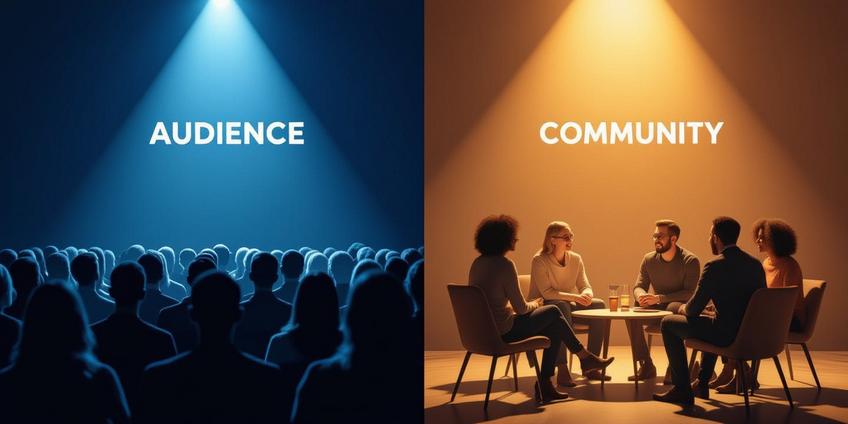
Understanding whether you are cultivating a community or an audience is fundamental to your strategy. The core distinction is simple: an audience is connected to you, while a community is connected to each other.
An audience is a group of people who follow or are interested in what a specific person, brand, or organization shares. The relationship is primarily one‑to‑many. A community is a group of people tied together by a shared interest, goal, or identity. The relationship is many‑to‑many.
Your goal dictates which you need. If you aim to broadcast information and grow your reach, you are building an audience. If your objective is to foster connection, support, and co-creation among members, you are building a community.
Four Foundational Distinctions
These four key differences will shape every decision you make, from platform choice to content strategy.
1. Relationship Structure
The fundamental architecture of interaction differs completely.
- Audience: This is a broadcast model. You are the central hub, and communication radiates outward from you to your followers. Think of a newsletter, a YouTube channel, or a keynote speech.
- Community: This is a networked model. You may have helped build the platform, but connections form between all members. You are a participant, not just a broadcaster. Think of a forum, a Slack group, or a mastermind circle.
2. Direction of Communication
This follows directly from the relationship structure.
- Audience: Communication is mostly one-way. You publish; they consume. Comments or replies are typically directed back to you, not to other audience members.
- Community: Communication is multi-directional. Everyone can initiate conversations, ask questions, provide answers, and share resources. The dialogue happens across the entire network.
3. Level and Type of Engagement
The nature of member involvement is a clear indicator.
- Audience: Engagement is largely passive. Metrics include views, opens, likes, and listens. The action is consumption.
- Community: Engagement requires active participation. Metrics shift to discussions started, peer-to-peer answers given, collaborative projects, and event attendance. The action is contribution.
4. Primary Goal
Your intended outcome defines the approach.
- Audience-Building: The goal is to maximize reach and attention. Success is measured by growing your follower count, increasing content visibility, and driving traffic or conversions.
- Community-Building: The goal is to maximize connection and mutual value. Success is measured by the strength of relationships, the quality of peer support, and the achievement of shared goals by members.
A Practical Test for Your Own Group
Ask yourself these two critical questions to diagnose what you’ve built.
If you stopped posting or engaging today, would activity cease?
- If all conversations and interactions would stop, you have an audience. They are there for your content.
- If members would continue talking, helping each other, and sharing without your direct input, you have a community. The bonds exist between them.
When your group gathers, what is the primary intent?
- Are people mainly there to consume what you provide (e.g., watch a live stream, read a post)? This signals an audience.
- Are people mainly there to connect with each other (e.g., discuss a topic, solve a shared problem)? This signals a community.
How Audience and Community Work Together
These concepts are not mutually exclusive; they are often stages in a relationship funnel. Your community is typically a subset of your audience.
- You first build an audience by attracting people to your content, product, or ideas.
- Within that audience, a segment will seek deeper connection and shared identity.
- You then invite that segment into a dedicated space (like a forum or membership) where they can form a community with each other.
For example, a SaaS company might have a large audience of blog readers and social media followers. Their community would be the active users who engage in the customer-only forum to share tips and best practices.
Actionable Steps to Foster Community
Shifting from an audience mindset to a community mindset requires intentional changes. Use this checklist to start the transition.
For Content Creators & Educators:
- ✓ Change your call-to-action. Instead of just "like and subscribe," ask "What’s your experience with this?" and encourage commenters to reply to each other.
- ✓ Host live sessions with a participatory format. Use Q&A not just for you to answer, but for attendees to answer each other's questions.
- ✓ Create a dedicated space. Move your most engaged followers from social media comments to a Discord server or group where they can connect directly.
- ✓ Showcase member contributions. Feature user-generated content, stories, or solutions in your main content channel.
For Startups & Businesses:
- ✓ Build a peer-to-peer support forum. Actively redirect common customer questions here and empower your most knowledgeable users to become moderators.
- ✓ Involve your community in development. Use a public roadmap or beta testing groups where users can vote on features and discuss them with each other.
- ✓ Host virtual or local meetups. Facilitate connections between your customers or users, making the event about their networking, not just your product pitch.
- ✓ Recognize and reward community leaders. Identify members who help others and give them recognition, early access, or a formal ambassador role.
For Nonprofits & Causes:
- ✓ Focus on shared identity. Frame your community around the identity of members (e.g., "advocates," "local guardians") rather than just supporters of your organization.
- ✓ Create peer-led local chapters. Provide the framework, but let members organize local meetings and events themselves.
- ✓ Facilitate skill-sharing. Connect experienced volunteers with new ones, creating mentorship relationships that operate independently of your staff.
- ✓ Highlight collective impact. Share stories that focus on what the group achieved together, not just what your organization did.
The most powerful groups are built when you stop being the sole voice and start being the facilitator of many voices. Start by applying one strategy from the checklist above. Observe how the dynamics change when your members begin talking to each other, not just to you. That shift in conversation is the moment an audience begins to transform into a community.
Frequently Asked Questions
The core difference is relationship structure: an audience is connected to you (one-to-many broadcast), while a community is connected to each other (many-to-many network). Audiences consume content; communities actively participate and create mutual value.
Ask two critical questions: First, if you stopped posting, would activity cease? If yes, it's an audience. Second, when your group gathers, is the primary intent to consume your content or connect with each other? Member-to-member interaction indicates a community.
Start by changing your calls-to-action to encourage peer responses, create a dedicated space like a forum or Discord for member connections, and actively showcase user contributions in your main channels. Facilitate rather than just broadcast.
Audience communication is primarily one-way (you publish, they consume). Community communication is multi-directional, with members initiating conversations, asking peers questions, and sharing resources across the entire network.
For audiences, track reach metrics: followers, views, likes. For communities, track engagement metrics: discussions started, peer-to-peer answers, collaborative projects, and member-led events. Focus on connection quality, not just quantity.
Yes, they often work together in a relationship funnel. Build an audience first through content, then invite engaged segments into dedicated community spaces. Your community is typically a valuable subset of your broader audience.
The biggest mistake is maintaining an audience mindset: broadcasting instead of facilitating, measuring only consumption metrics, and not creating spaces for peer-to-peer interaction. Success requires shifting from being the central voice to being a conversation facilitator.
Thank you!
Thank you for reaching out. Being part of your programs is very valuable to us. We'll reach out to you soon.