Empathy Maps: Understanding Your Employees
Learn to use empathy maps for understanding employee perspectives. This practical guide helps leaders improve management decisions and team engagement.
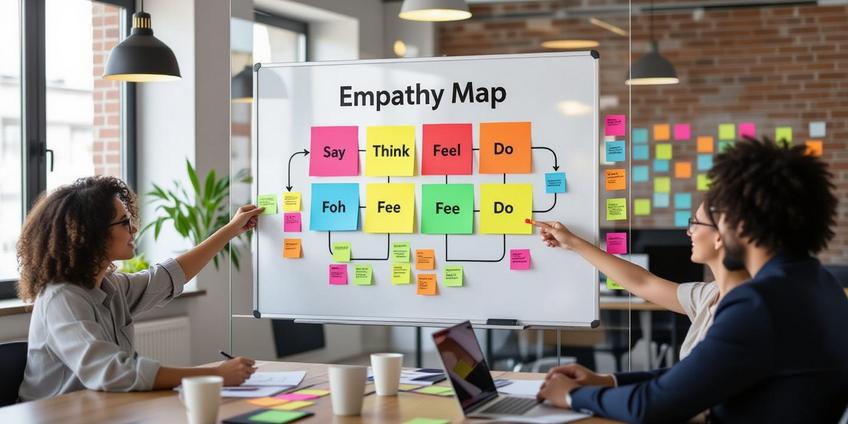
Key Points
- ✓ Map employee experiences using four quadrants: Says, Thinks, Does, and Feels to uncover authentic perspectives and unspoken thoughts.
- ✓ Apply empathy maps to diagnose workplace friction, manage organizational change, and build psychological safety through evidence-based understanding.
- ✓ Translate map insights into action by formulating 'How Might We' questions and designing targeted engagement strategies for specific employee personas.
Thank you!
Thank you for reaching out. Being part of your programs is very valuable to us. We'll reach out to you soon.
Visualizing Employee Perspectives for Better Management
An empathy map is a structured diagram that captures what your team members experience in their work environment. It moves beyond surface-level feedback to document their spoken words, internal thoughts, observable actions, and underlying emotions. This collaborative tool externalizes assumptions and builds a shared, evidence-based understanding of your employees' reality, enabling more informed and supportive leadership decisions.
Core Elements of an Employee Empathy Map
The standard framework organizes insights into four primary quadrants, creating a holistic portrait of an individual or persona.
Says: This quadrant contains direct quotes and verbal expressions gathered from one-on-one conversations, surveys, or team meetings. Record phrases verbatim to maintain authenticity. For example, an employee might state, "I spend over an hour every morning just figuring out what to prioritize," or "I never get feedback until something is wrong."
Thinks: Here, you capture the employee's internal narrative—their ambitions, worries, and unspoken questions. This often differs from what they say aloud. They might think, "My ideas aren't valued in this department," or "If I ask for help, I'll look incompetent." Uncovering these thoughts requires reading between the lines of interviews and observing behavioral cues.
Does: This section documents observable actions and behaviors. What does the employee actually spend their time doing? Actions might include: "Regularly stays 30 minutes late to finish reports," "Avoids contributing in cross-departmental meetings," or "Frequently uses personal messaging apps to ask colleagues quick questions."
Feels: The most critical quadrant, this explores the employee's emotional state, motivations, frustrations (pains), and aspirations (gains). Use emotion words like "anxious about missing deadlines," "frustrated by inconsistent communication from leadership," "proud when a project receives client praise," or "motivated by opportunities to mentor others."
Some teams expand the map to include Hears (influences from company gossip, manager feedback, or industry news) and Sees (elements in their physical or digital workspace, like outdated software or celebratory emails). This provides richer context about their environment.
Practical Applications for Team Leaders
Implementing empathy maps addresses specific managerial challenges by grounding decisions in employee experience.
- Build Psychological Safety and Trust: The act of creating a map signals to employees that their perspective is valued. When you accurately address a documented pain point, such as unclear approval processes, you demonstrate that leadership listens and acts, which strengthens trust.
- Manage Organizational Change Effectively: Before rolling out a new software system or policy, map the anticipated experience of different employee personas. This proactive step helps you identify potential points of resistance, tailor communication, and design better support materials to ease the transition.
- Diagnose and Reduce Workplace Friction: Persistent issues like missed deadlines or low morale often stem from unseen frustrations. Mapping reveals the root causes—perhaps a "Feels" quadrant shows widespread anxiety about unrealistic expectations, explaining the "Does" behavior of rushed, error-prone work.
- Develop Targeted Engagement Strategies: Generic engagement initiatives often fail. Creating personas for distinct groups (e.g., new hires, remote team members, tenured experts) through empathy mapping allows you to design recognition, development, and communication strategies that resonate with their specific motivations and pains.
A Step-by-Step Guide to Creating Your First Map
Follow this actionable process to move from concept to concrete insights.
1. Define Your Focus and Gather Data Begin by selecting a specific focus. This could be a role (e.g., "Customer Support Specialist"), a scenario (e.g., "Employee during quarterly planning"), or a persona based on common traits. Avoid mapping a generic "employee."
Next, collect qualitative data to populate your map authentically. Relying on assumptions will invalidate the exercise.
- Conduct confidential, one-on-one interviews using open-ended questions.
- Distribute anonymous surveys asking about daily challenges and motivators.
- Observe team interactions and workflows where possible.
- Review existing feedback from exit interviews or performance reviews.
2. Facilitate a Collaborative Mapping Session Assemble a small, cross-functional group (e.g., a manager, a peer, and someone from HR) to analyze the gathered data. Use a physical whiteboard with sticky notes or a digital collaboration tool like Miro or MURAL.
- Draw the standard four-quadrant map.
- As a group, discuss the data and write individual insights on sticky notes, placing them in the relevant quadrant ("Says," "Thinks," etc.).
- Encourage debate and discussion. If an insight is speculative, mark it with a "?" to indicate it's a hypothesis needing validation.
3. Synthesize Insights and Define Action Once the quadrants are populated, shift from collection to analysis. Look for patterns and tensions between quadrants.
- Identify Key Pains: What frustrations ("Feels") are connected to specific tasks ("Does") or quotes ("Says")? For instance, the quote "I'm in back-to-back meetings all day" plus the action "Does focused work after hours" points to a pain of "feeling unable to control my schedule."
- Identify Key Gains: What brings satisfaction or motivation? Note what employees value, such as "feels accomplished when solving complex problems independently."
- Formulate "How Might We" Questions: Turn insights into actionable problem statements. For example: "How might we reduce interruptions during deep work periods?" or "How might we provide more constructive feedback in the moment?"
4. Translate Findings into Concrete Plans The map itself is not the outcome; the actions it inspires are. Use the synthesis to drive change.
- Address Immediate Pains: If a major pain point is identified, such as a broken tool, initiate a fix immediately.
- Inform Larger Initiatives: Use the insights to design a new onboarding program, revise a workflow, or shape a team training workshop.
- Create a Supporting Artifact: Develop a simple employee persona document summarizing the map's key insights to keep the employee's perspective central in ongoing projects.
Checklist for an Effective Empathy Mapping Session
- ✓ Defined a specific employee persona or scenario to map.
- ✓ Gathered input from at least 3-5 real employees via interview or survey.
- ✓ Included diverse perspectives in the mapping workshop (not just management).
- ✓ Populated all quadrants with specific, data-backed notes.
- ✓ Distinguished between observed data and team assumptions.
- ✓ Synthesized findings into clear "pains" and "gains."
- ✓ Defined at least one "How Might We" question or immediate next step.
By systematically visualizing your employees' experiences, you move from managing tasks to leading people. This practice fosters a culture of respect, improves communication, and ensures that operational strategies are aligned with the human needs that ultimately determine productivity and success.
Frequently Asked Questions
The standard framework includes four quadrants: Says (direct quotes), Thinks (internal narrative), Does (observable actions), and Feels (emotional state). Some teams expand to include Hears (external influences) and Sees (environmental factors) for richer context.
Before implementing changes, mapping anticipated employee experiences identifies potential resistance points. This allows leaders to tailor communications, design better support materials, and ease transitions by addressing specific concerns revealed in the Feels and Thinks quadrants.
Define a specific focus, such as a role or scenario, and gather qualitative data through interviews, surveys, and observations. Avoid generic mappings and rely on authentic employee input rather than assumptions to ensure validity.
The mapping process signals that employee perspectives are valued. When leadership addresses documented pain points, it demonstrates listening and action, which strengthens trust and creates a safer environment for open dialogue.
Avoid mapping generic 'employees' without specific focus, relying on assumptions instead of real data, and excluding diverse perspectives. Always distinguish between observed data and team hypotheses during the synthesis phase.
Synthesize patterns to identify key pains and gains, then formulate 'How Might We' questions. Use these to drive immediate fixes, inform larger initiatives like training programs, and create persona documents to keep employee perspectives central.
Yes, use digital collaboration tools like Miro or MURAL for remote mapping sessions. Gather data via virtual interviews and surveys. The framework adapts well to understanding the unique challenges and experiences of distributed team members.
Thank you!
Thank you for reaching out. Being part of your programs is very valuable to us. We'll reach out to you soon.