Pitch Deck Mistakes That Turn Investors Away
Learn the most common pitch deck mistakes that alienate investors and how to fix them. Transform your presentation into a compelling investor-focused narrative.
Key Points
- ✓ Limit your pitch deck to 10-15 slides with one idea per slide for maximum clarity and impact.
- ✓ Craft a cohesive narrative that starts with a hook and builds to a clear call-to-action.
- ✓ Provide concrete evidence including traction data, honest competitive analysis, and grounded financial projections.
Thank you!
Thank you for reaching out. Being part of your programs is very valuable to us. We'll reach out to you soon.
Common Presentation Errors That Alienate Potential Backers
A pitch deck is your primary tool for securing investment, yet many founders undermine their own efforts with avoidable mistakes. These errors signal poor preparation, a lack of strategic focus, or a fundamental misunderstanding of what investors need to make a decision. The result is often an instant dismissal, as investors review hundreds of decks, typically spending under four minutes on each. Your goal is not to tell them everything, but to compel them to want to learn more.
This guide outlines the most frequent pitch deck mistakes and provides practical fixes to transform your presentation into a compelling, investor-focused narrative.
Overloading Slides with Information
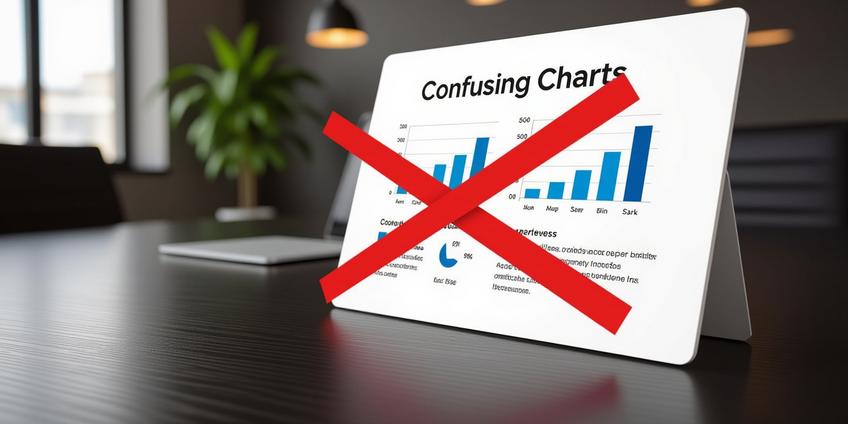
The most common error is treating a slide as a document. Walls of text, complex graphs, and cramming 30+ slides into a deck bury your key points. Founders often dive into technical minutiae that investors do not need at this stage.
Fix: Prioritize Clarity and Brevity
- Limit your deck to 10-15 slides maximum. The core should cover: Problem, Solution, Market, Traction, Competition, Business Model, Team, Financials, and The Ask.
- Use the "one idea per slide" rule. Each slide should convey a single, powerful concept.
- Employ large fonts, strong visuals, and minimal text. Your slides are a visual aid for your narrative, not a script.
Investors skim. If they can’t grasp your core premise in the first three slides, you’ve lost them.
Failing to Build a Cohesive Narrative
A deck that is a collection of disjointed facts lacks impact. A weak or absent story—no compelling opening, a scattered flow, or a failure to connect the problem to your unique solution—leaves investors unengaged and confused.
Fix: Craft a Gripping Story Arc
- Start with a hook. Open with a relatable, painful problem your target customer faces.
- Present your solution as the inevitable answer. Show how it elegantly resolves that pain.
- Build credibility. Introduce traction, market validation, and your team’s expertise.
- End with vision and appeal. Conclude with your ambitious future and a clear, confident ask. Your "secret sauce" or key differentiator should be the emotional peak of this story.
Presenting a Vague Value Proposition
Using generic buzzwords like "disruptive," "AI-powered," or "platform" without concrete explanation is a major red flag. Similarly, presenting a huge, undifferentiated Total Addressable Market (TAM) without showing you understand the specific, reachable segment (SOM) signals a lack of operational insight.
Fix: Explicitly Demonstrate Customer Value
- Articulate the "aha" moment. Clearly state: "We help [specific customer] achieve [specific outcome] by [how your solution works], which is [X times faster/cheaper/better] than the current alternative."
- Go beyond TAM. Detail your Serviceable Obtainable Market (SOM) with customer insights. Show you know exactly who will buy first and how you will reach them.
- Detail your go-to-market strategy. A vague plan suggests you haven't thought through execution.
Neglecting Traction and Competition
Skipping the traction slide or claiming you have "no competitors" destroys credibility. Every company has competition, even if it's an alternative way of solving the problem (like a spreadsheet). Lack of traction data, or a weak growth story, leaves investors with no proof of concept.
Fix: Provide Evidence and Context
- Highlight your growth story. Use simple charts to show month-over-month increases in revenue, users, or key engagement metrics. A flat line is a warning sign.
- Construct an honest competitive landscape. Use a 2x2 matrix comparing key features or benefits. Visually plot where you and your competitors sit.
- Articulate your sustainable edge. Don't just list features. State your advantage clearly: e.g., "Our proprietary algorithm delivers a 30% efficiency gain, which directly translates to lower customer cost."
Using Unrealistic or Vague Financials
Projections that show a hockey-stick growth curve without underlying assumptions appear naive. A funding request that simply states the money will be used to "expand operations" or "scale marketing" shows a lack of operational planning.
Fix: Ground Your Numbers and Specify Use of Funds
- Build evidence-based projections. Base your forecasts on current unit economics, conversion rates, and validated customer acquisition costs. Include key assumptions in an appendix.
- Break down the ask with precision. State: "We are raising [$X] to achieve [Y and Z milestones] over [18 months]. This will fund [A number of hires in engineering/sales] and the launch of [specific product feature or market]."
Omitting a Clear Call to Action
Ending your deck without a definitive next step leaves the investor wondering what you want from them. Ambiguity at this critical moment can stall all momentum.
Fix: State Your Needs Explicitly Your final slide must contain:
- The exact amount you are raising.
- A concise, bulleted list of what the capital will achieve (key milestones).
- A simple, direct question or statement: "We are looking for partners to lead our $2M seed round. Are you interested in discussing the term sheet?"
Additional Pitfalls to Avoid
- Jargon Overload: Assume your investor is smart but not a specialist in your field. Explain complex tech in simple, benefit-oriented terms.
- Ignoring Investor Fit: Research the fund. Pitching a pre-revenue idea to a growth-stage investor, or a B2B SaaS model to a biotech VC, wastes everyone's time.
- The "Empty Shell" Deck: A beautifully designed deck with stunning graphics but lacking substantive content is immediately seen as style over substance.
- Being Unprepared for Questions: Your deck should anticipate tough questions about risks, unit economics, and defensibility. Have backup slides ready.
Pitch Deck Preparation Checklist Use this list to audit your deck before sending it.
- ✓ The deck is 10-15 slides long.
- ✓ Slides use large fonts, high-contrast visuals, and minimal text.
- ✓ The narrative flows logically: Problem > Solution > Why Now > Why Us > The Future.
- ✓ The value proposition is stated in one clear, customer-centric sentence.
- ✓ Market size is presented with a focus on the serviceable, obtainable segment.
- ✓ A traction slide shows concrete, upward-trending metrics.
- ✓ A competitive landscape slide honestly positions the company and shows a defined advantage.
- ✓ Financial projections are grounded in stated assumptions and current performance.
- ✓ The "Ask" slide specifies the amount, key use of funds, and desired milestones.
- ✓ The deck has been reviewed by an advisor or mentor unfamiliar with the business for clarity.
- ✓ You have practiced the verbal pitch that accompanies the slides until it feels natural and confident.
Tailoring your narrative to the investor's specific focus—whether it's market validation for a seed round or scaling metrics for a Series A—is crucial. Remember, the deck is a tool to start a conversation. Its job is to be so clear, compelling, and credible that the only logical next step for the investor is to ask for a meeting.
Frequently Asked Questions
Keep your pitch deck to 10-15 slides maximum. This forces you to prioritize the most critical information: Problem, Solution, Market, Traction, Competition, Business Model, Team, Financials, and The Ask.
Articulate the 'aha' moment clearly: state who you help, what outcome they achieve, how your solution works, and why it's better than alternatives. Avoid generic buzzwords and focus on specific customer benefits.
Every company has competition, even if it's alternative solutions. Claiming no competition shows lack of market understanding. Instead, create an honest competitive landscape and articulate your sustainable advantage.
Base projections on current unit economics, conversion rates, and validated customer acquisition costs. Include key assumptions and avoid hockey-stick curves without underlying evidence.
Specify the exact amount you're raising, a bulleted list of what the capital will achieve (key milestones), and a direct call-to-action inviting discussion about the investment round.
Critical. Investors review hundreds of decks quickly. Your narrative should flow logically: Problem > Solution > Why Now > Why Us > The Future. A disjointed deck gets dismissed instantly.
Overloading slides with text, using small fonts, complex graphs, and cramming too much information. Use large fonts, strong visuals, minimal text, and follow the 'one idea per slide' rule.
Thank you!
Thank you for reaching out. Being part of your programs is very valuable to us. We'll reach out to you soon.