The T-Shaped Employee: Why Width Matters as Much as Depth
Discover why T-shaped employees with broad skills and deep expertise drive collaboration, innovation, and agility in modern organizations. Learn to develop this balanced skillset.
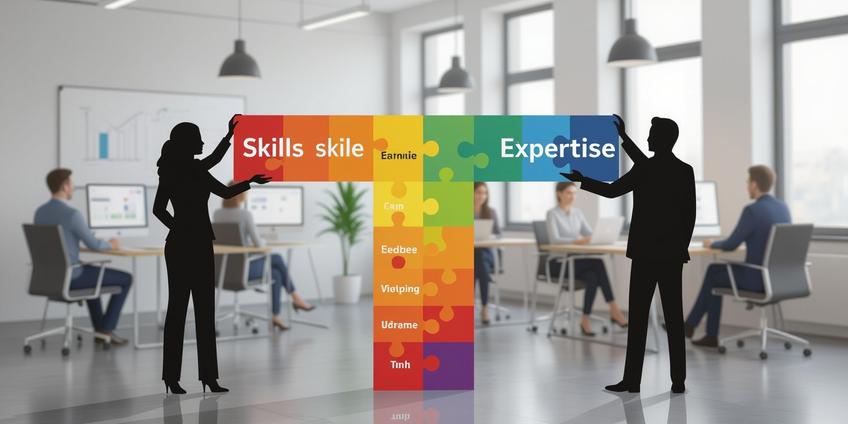
Key Points
- ✓ Cultivate deep expertise in your primary domain while systematically learning adjacent field fundamentals to improve cross-functional collaboration and communication.
- ✓ Develop strong interpersonal skills like communication, empathy, and teamwork to bridge departmental gaps and drive more innovative, holistic solutions.
- ✓ Actively seek cross-training, shadowing, and projects outside your core responsibilities to build organizational agility and advance your career trajectory.
Thank you!
Thank you for reaching out. Being part of your programs is very valuable to us. We'll reach out to you soon.
The Versatile Professional: Balancing Broad Skills with Specialized Knowledge
The modern workplace demands more than isolated expertise. A T-shaped employee model provides a powerful framework for individual and organizational success. This approach describes a professional who combines deep expertise in one area (depth) with broad, cross‑disciplinary skills and understanding (width). The critical insight is that the width matters just as much as the depth because it directly enables communication, collaboration, flexibility, and superior problem‑solving.
Defining the T-Shaped Model
The "T" is a simple but effective metaphor for a specific skillset structure.
- The Vertical Bar (Depth): This represents strong, specialist skills and experience in a particular field. This is your primary domain of mastery, such as software engineering, financial analysis, or clinical research. It allows you to perform at a high level, push complex work forward, and provide authoritative contributions in your core area.
- The Horizontal Bar (Width): This signifies broad knowledge, transferable skills, and exposure to multiple adjacent areas. It includes understanding basics in fields like marketing, operations, user experience, or project management. Crucially, it is also built on strong interpersonal or "soft" skills like communication, empathy, and teamwork.
Specialists without breadth struggle to integrate, and generalists without depth struggle to add unique value. The T-shaped professional balances both.
The Critical Importance of Broad Skills
Why does developing this horizontal bar warrant equal focus to deepening your specialty? The research points to several concrete, organizational benefits.
Enhanced Collaboration and Communication Employees with broad understanding can "speak the language" of different functions. A developer who grasps core UX principles can collaborate more effectively with designers. A marketer who understands basic data analytics can communicate more clearly with data scientists. This shared vocabulary and empathy for colleagues' needs smooths coordination and reduces friction.
More Effective and Innovative Problem-Solving T-shaped individuals don't see problems solely through the lens of their specialty. They can draw from multiple disciplines, recognize connections across teams, and generate more holistic, end‑to‑end solutions. Instead of a narrow, siloed fix, they contribute to innovative approaches that consider the entire system or customer journey.
Greater Organizational Flexibility and Agility When priorities shift or teams face capacity constraints, T-shaped employees can adapt. Because they understand adjacent domains, they can step into related tasks, provide meaningful support to teammates, and help the organization pivot without always requiring a deep specialist. This builds inherent resilience.
Higher Overall Productivity Work that doesn't require a deep specialist can be competently handled by a T-shaped employee. This frees true experts to concentrate on the high-stakes, complex problems that most need their depth of knowledge, optimizing the organization's use of its most specialized talent.
Building Your Own T-Shaped Profile
Developing this dual-focus skillset is an active, ongoing process. Here is a practical roadmap.
1. Intentionally Deepen Your Vertical Expertise Your depth remains your foundation. Continue building advanced, specialist skills in your primary domain.
- Pursue advanced certifications or training in your field.
- Tackle increasingly complex projects that stretch your core capabilities.
- Stay current with the latest research, tools, and methodologies in your specialty.
2. Systematically Broaden Your Horizontal Skills This requires proactive curiosity and stepping outside your comfort zone.
- Learn Adjacent Fundamentals: Dedicate time to understanding the basics of functions that interact with your own. If you are in finance, learn the core principles of the sales cycle. If you are in design, understand the fundamentals of front-end development.
- Action: Complete introductory online courses in a related field each quarter.
- Action: Read one industry blog or newsletter from a different department each month.
- Develop Core Interpersonal Skills: These are the glue of the horizontal bar. Focus on:
- Communication: Practice explaining your complex work to non-experts.
- Empathy and Listening: Actively seek to understand your colleagues' challenges and constraints.
- Teamwork and Collaboration: Focus on shared goals over individual credit.
- Seek Cross-Functional Experiences: Knowledge is solidified through practice.
- Volunteer for projects that require a team with mixed skillsets.
- Ask to shadow a colleague in another department for a day.
- Participate in or propose cross-training sessions within your organization.
A Checklist for Cultivating Width
Use this list to audit and guide your development of broad skills.
- ✓ I can explain my team's core goals and challenges to someone in a completely different department.
- ✓ I have a basic understanding of the workflow and key metrics for at least two other teams I regularly interact with.
- ✓ I have completed formal or informal training in a skill outside my primary expertise in the last year.
- ✓ I actively listen in meetings with other departments and ask clarifying questions to ensure understanding.
- ✓ I have volunteered for a task or project outside my usual responsibilities in the last six months.
- ✓ I can name the primary internal "customers" or stakeholders for my work and describe their needs.
For organizations, fostering a culture that values and creates T-shaped employees leads to stronger, more resilient teams. Teams composed of such individuals are more cross-functional, stable, and able to rotate responsibilities, which directly supports agile ways of working and continuous learning. For the individual, developing width makes work more varied and engaging, boosts creative thinking, increases long-term employability, and builds a stronger foundation for future leadership roles. In a fast-changing, interconnected business environment, this balance is not just advantageous—it is essential.
Frequently Asked Questions
A T-shaped employee combines deep specialization in one area (the vertical bar) with broad knowledge across multiple adjacent disciplines and strong interpersonal skills (the horizontal bar). This model balances expertise with versatility to enhance collaboration and problem-solving.
Broad skills enable effective communication across departments, foster innovative problem-solving by connecting different perspectives, and increase organizational agility. Without width, deep specialists struggle to collaborate and adapt to changing priorities.
Dedicate time each quarter to introductory courses in adjacent fields, regularly read industry blogs from other departments, and volunteer for cross-functional projects. Simultaneously, continue advanced training in your core specialty to maintain depth.
They enhance team collaboration, drive more innovative solutions, increase operational flexibility during shifts, and optimize specialist resources. Organizations with T-shaped teams experience better coordination and resilience.
Time constraints and the fear of diluting expertise are key challenges. Address these by allocating dedicated learning time, focusing on adjacent rather than distant fields, and framing broad skills as complementary rather than competitive with your specialty.
Encourage cross-functional training, create opportunities for job shadowing, reward collaboration over siloed work, and include broad skill development in performance goals. Model T-shaped behavior by learning about team members' domains.
Unlike a generalist with shallow knowledge across many areas, a T-shaped professional has deep expertise in one domain supplemented by broad adjacent skills. This combination allows for authoritative contributions while maintaining cross-functional effectiveness.
Thank you!
Thank you for reaching out. Being part of your programs is very valuable to us. We'll reach out to you soon.