Video Interviewing: Asynchronous vs. Live
Compare asynchronous vs live video interviewing to optimize hiring efficiency. Discover when to use each format and implement hybrid strategies.
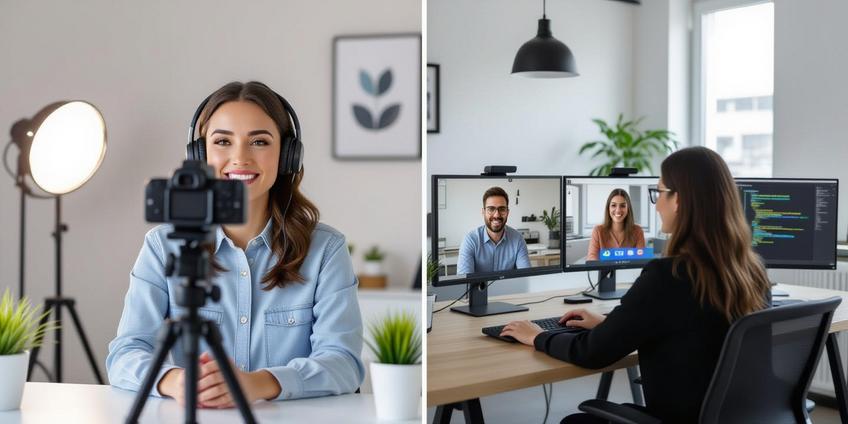
Key Points
- ✓ Use asynchronous video interviews for high-volume early screening to save time and standardize evaluations across candidates.
- ✓ Deploy live video interviews for later stages to assess complex skills, build rapport, and evaluate cultural fit through real-time interaction.
- ✓ Implement a hybrid strategy combining asynchronous screening followed by live interviews to balance efficiency with personal engagement.
Thank you!
Thank you for reaching out. Being part of your programs is very valuable to us. We'll reach out to you soon.
Comparing Pre-Recorded and Real-Time Video Interviews
Video interviewing is now a standard part of the hiring process, but not all formats are the same. The choice between asynchronous and live video interviewing shapes your hiring efficiency, candidate experience, and the quality of your assessments. Understanding their distinct applications is key to building an effective recruitment strategy.
Core Definitions and Key Distinctions
Asynchronous video interviews, also known as one-way or pre-recorded interviews, involve candidates recording their answers to a fixed set of questions. They complete this on their own time, without a live interviewer present. Recruiters and hiring teams then review these recordings at their convenience to evaluate responses.
Live video interviews are synchronous, real-time conversations conducted via platforms like Zoom or Microsoft Teams. This format mirrors an in-person interview, allowing for immediate dialogue, follow-up questions, and clarifications between the interviewer and candidate.
The fundamental differences are best understood through their practical implications:
| Aspect | Asynchronous (One-way) | Live (Synchronous) |
|---|---|---|
| Interaction | One‑way, no real-time feedback | Two‑way, real-time dialog |
| Scheduling | No scheduling; on‑demand for both sides | Requires calendar coordination; time zones can be a bottleneck |
| Scalability | High – can screen hundreds with minimal recruiter time | Low–medium – each session consumes interviewer time |
| Question Consistency | Same questions and conditions for all candidates | Can tailor and change questions based on responses |
| Assessment Depth | Good for basic fit and communication; limited probing | Strong for nuance, judgment, culture fit, and agility |
| Candidate Experience | Flexible, less pressure, but can feel impersonal | Personal, relationship‑building, but more stressful and time‑bound |
| Typical Use | Early‑stage screening, high‑volume roles | Later stages, senior/strategic roles, final rounds |
| Recruiter Workload | Low ongoing load; heavy lifting is setup and review | High per candidate; requires live participation every time |
Strategic Advantages and Limitations for Employers
Each video interviewing format offers specific benefits and comes with inherent trade-offs. Your choice should align with your hiring stage and goals.
Asynchronous Video Interviewing: Pros and Cons
Advantages:
- Speed and Scalability: This method drastically cuts screening time, with some teams reporting reductions in time-to-hire by up to 50% for high-volume roles. It allows you to process large applicant pools without linearly increasing interviewer hours.
- Eliminates Scheduling Friction: Candidates complete interviews on their own schedule, removing the back-and-forth of calendar coordination and overcoming time-zone conflicts.
- Standardized Evaluation: Every candidate receives the same questions, presented in the same way, with identical time limits. This creates a consistent, comparable dataset that supports fairer initial assessments.
- Enhanced Collaboration: Recordings can be easily shared, paused, and rewatched by multiple stakeholders, facilitating collaborative hiring decisions.
Drawbacks:
- Lacks Real-Time Depth: You cannot ask for clarification or probe deeper into an interesting answer, which can limit your understanding of a candidate’s thought process.
- Risk of Impersonal Experience: If overused or deployed at an inappropriate stage, the process can feel transactional to candidates, potentially harming your employer brand.
- Poor Fit for Complex Roles: It is weaker at assessing nuanced skills like leadership presence, sophisticated stakeholder management, and real-time strategic judgment.
Live Video Interviewing: Pros and Cons
Advantages:
- Rich, Interactive Assessment: The immediate back-and-forth allows you to test a candidate’s ability to think on their feet, ask follow-up questions, and explore scenarios in depth.
- Superior Gauge of Soft Skills and Fit: This format provides a more accurate sense of personality, communication style, and potential cultural alignment with your team.
- Stronger Engagement and Selling Opportunity: It fosters a personal connection, gives candidates a feel for the people they might work with, and provides a natural forum for them to ask detailed questions about the role.
Drawbacks:
- Significant Time and Scheduling Cost: Coordinating calendars across time zones is a common bottleneck. The live time commitment from interviewers can lead to burnout when screening many applicants.
- Inherently Limited Scalability: It is impractical to conduct live video interviews with every applicant for a high-volume opening.
- Potential for Inconsistency: Without a strict structure, different interviewers may ask varying questions or evaluate candidates differently, introducing bias.
When to Deploy Each Video Interviewing Format
Your decision should be driven by the role’s requirements and its stage in the hiring funnel.
Opt for asynchronous video interviewing when:
- You are managing high-volume hiring for roles like customer support, retail, sales development, or seasonal positions.
- You need an efficient early-stage screening tool to filter applicants immediately after resume review.
- You are hiring across multiple time zones or for fully remote positions.
- Your priority is a standardized, comparable first impression of all candidates to ensure fairness and efficiency.
Opt for live video interviewing when:
- The role demands assessment of leadership, complex problem-solving, or real-time agility.
- You are at a later-stage or final-round interview where building rapport and deep mutual evaluation are critical.
- You need to actively sell the role and company culture to in-demand candidates.
- You are filling niche, specialized, or hard‑to‑fill positions where each candidate warrants significant attention.
Implementing a Hybrid Video Interviewing Strategy
The most effective approach combines both formats, leveraging their respective strengths. A hybrid model follows a clear sequence: automation upfront, personalization where it counts.
Use Asynchronous Video for Initial Screening Deploy one-way video interviews as a structured filter after the initial resume review. This quickly narrows a large pool to a qualified shortlist based on standardized criteria.
Progress Shortlisted Candidates to Live Rounds Invite your top candidates from the asynchronous stage into live video interviews. This is where you conduct deeper behavioral interviews, assess culture fit, and allow candidates to engage directly with the team.
This strategy maximizes recruiter efficiency during the high-volume screening phase while reserving valuable live interaction for the candidates who are the best fit. It creates a process that is both scalable and personally engaging.
Practical Checklist for Implementation
For Asynchronous (One-Way) Interviews:
- ✓ Craft concise, role-specific questions. Focus on competencies that can be assessed without follow-up (e.g., "Tell us about a time you handled a difficult customer").
- ✓ Set clear expectations. In your invitation, specify the number of questions, time limits per answer, and the technology required.
- ✓ Provide a practice question. Allow candidates to test their audio, video, and comfort with the format before starting the official interview.
- ✓ Establish a consistent scoring rubric. Define what a strong, average, and weak answer looks like for each question to ensure fair evaluation.
- ✓ Communicate timelines. Let candidates know when they can expect an update after submitting their recording.
For Live (Synchronous) Interviews:
- ✓ Standardize core questions. While allowing for natural flow, ensure all candidates for the same role are asked a core set of key behavioral questions.
- ✓ Minimize technical issues. Send a clear meeting link in advance, and have a backup plan (like a phone number) in case of connection problems.
- ✓ Create a structured interview guide. This should include questions, follow-up probes, and rating scales to maintain consistency across different interviewers.
- ✓ Train interviewers. Brief them on the platform, the interview structure, and techniques for making candidates feel comfortable on camera.
- ✓ Dedicate time for candidate questions. Actively invite and thoroughly answer the candidate’s questions—this is a critical part of the mutual evaluation process.
The hybrid model of "asynchronous first, live later" is not just about saving time; it's about intentionally designing a candidate journey that is efficient without being impersonal. It respects the candidate's time during screening and invests in human connection when it matters most for decision-making.
By strategically implementing both asynchronous and live video interviewing, you build a hiring process that is robust, fair, and capable of identifying the best talent efficiently.
Frequently Asked Questions
Asynchronous interviews are pre-recorded with no real-time interaction, while live interviews are synchronous conversations allowing immediate dialogue and follow-up questions.
Use asynchronous interviews for high-volume hiring, early-stage screening, roles across multiple time zones, or when you need standardized evaluations for fairness and efficiency.
Live interviews require significant scheduling coordination, consume interviewer time per candidate, and have limited scalability for high-volume roles, making them less efficient for initial screening.
A hybrid strategy uses asynchronous interviews for initial screening to filter large pools efficiently, then progresses shortlisted candidates to live interviews for deeper assessment and relationship building, balancing scalability with personal engagement.
Craft role-specific questions, provide clear expectations and a practice question, establish a consistent scoring rubric, and communicate timelines to candidates for a smooth experience.
Standardize core questions across interviewers, create structured interview guides with rating scales, train interviewers on the platform and techniques, and dedicate time for candidate questions.
Live video interviews are superior for assessing culture fit as they allow real-time interaction, observation of communication style, and personal connection that reveals alignment with team dynamics.
Thank you!
Thank you for reaching out. Being part of your programs is very valuable to us. We'll reach out to you soon.
References
- Asynchronous video interview vs Synchronous ...
- Live vs Asynchronous Video Interview: What to Know
- One-Way vs Live Video Interviews: Which Should You Use?
- The Pros and Cons of Asynchronous Video Interviews
- Live vs. Prerecorded (One-way) Video Interviews
- About Video Interviewing
- Live vs. One-Way Interviewing: Key Differences and Use ...
- Live Vs. Asynchronous Interviews: Benefits and Drawbacks
- Hold On, What The Heck Are Asynchronous Interviews?