On-Demand Pay Apps: Financial Wellness Tech
Discover how on-demand pay apps enhance financial wellness. Learn EWA benefits for employees and employers, implementation strategies, and best practices.
Key Points
- ✓ On-demand pay apps provide a 0% interest alternative to payday loans, helping employees manage cash flow without accumulating high-cost debt.
- ✓ Implementing earned wage access can boost employee retention by up to 41% and improve productivity by reducing financial stress and distractions.
- ✓ Successful EWA integration requires careful vendor assessment for payroll compatibility, transparent fee structures, and clear communication promoting responsible use.
Thank you!
Thank you for reaching out. Being part of your programs is very valuable to us. We'll reach out to you soon.
Financial Wellness Technology for Immediate Wage Access
On-demand pay applications represent a significant shift in how employees manage their finances between traditional pay cycles. These tools, often categorized under earned wage access (EWA), function as a core component of modern financial wellness technology. They allow workers to retrieve a portion of their already accrued earnings prior to the scheduled payday, directly through a mobile platform synced with company payroll or time-tracking systems.
This technology addresses a critical pain point: the mismatch between expense due dates and paycheck arrival. By providing a regulated, low-cost alternative to predatory lending, it serves as a practical tool for improving individual financial stability and organizational health.
Core Mechanics of Earned Wage Access Systems
Understanding how this financial wellness tech operates is the first step to evaluating its fit. The process is designed for simplicity and security.
- Secure Data Integration: The application establishes a direct, encrypted link with the employer's timekeeping and payroll software. This connection allows for the real-time calculation of net wages earned to date, based on hours logged or salary accrued.
- Controlled Access Limits: To prevent overextension, systems typically cap withdrawals at 50–80% of an employee's earned net pay. This limit ensures a sufficient amount remains for standard payroll deductions and taxes on payday.
- Streamlined Funding and Repayment:
- When an employee initiates a transfer, the EWA provider advances the requested funds, depositing them into a designated bank account, debit card, or payroll card.
- The advanced sum, along with any applicable service fee, is then automatically reconciled during the next standard payroll processing cycle. The deduction appears on the employee's paystub, creating a clear audit trail.
- Transparent Fee Structures: A key differentiator from credit products is the cost model. These services typically charge no interest. Fees, if any, are usually a small, disclosed flat transaction fee (e.g., $1–$5 per transfer) rather than an annual percentage rate (APR). In many employer-sponsored models, the company covers this fee as a benefit.
This model is fundamentally different from a loan. Employees are accessing wages they have already earned, not borrowing against future income. The provider's role is to facilitate early access, not extend credit.
Strategic Benefits for Employee Financial Health
The value of this financial wellness tech is most apparent in its direct impact on workers' daily lives and long-term habits.
- Provides a Low-Cost Alternative: It offers a 0% interest option to cover short-term gaps, directly competing with high-cost solutions like payday loans (which can carry APRs near 400%), bank overdraft fees (averaging ~$35 per incident), and late payment penalties on bills.
- Reduces Acute Financial Stress: By smoothing cash flow, employees can address urgent needs—such as a car repair to get to work or a utility bill to avoid shut-off—without resorting to distress borrowing. Research consistently links high financial stress to lost productivity and distracted workers.
- Enables Proactive Cash-Flow Management: Workers gain the ability to align income with real-world expense cycles. This control helps manage essentials like rent, groceries, and fuel without accumulating new debt.
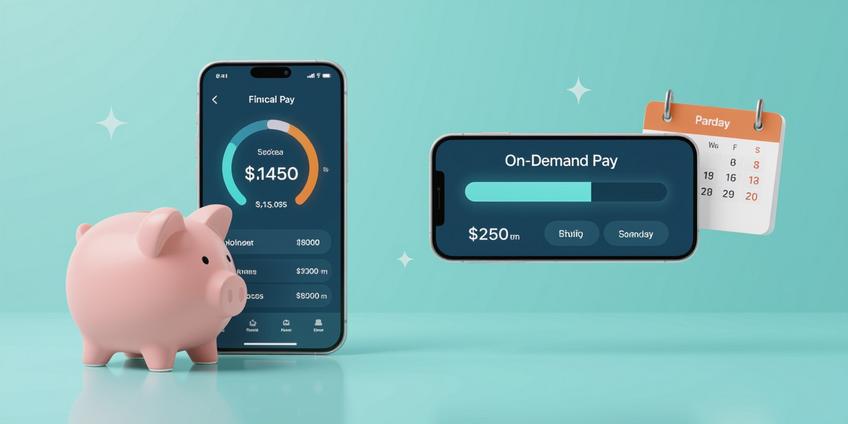
- Encourages Positive Financial Behaviors: Leading platforms extend beyond simple early access. They incorporate features like real-time earnings dashboards, spending insights, and automated savings tools (e.g., "savings jars" that round up transfers or allocate a percentage to an emergency fund). This positions the app as a holistic financial wellness tool.
Employee Checklist for Responsible Use
- ✓ Treat accessed wages as a cash-flow tool, not supplemental income.
- ✓ Compare any app transaction fees to the cost of your bank's overdraft fee or a late payment charge.
- ✓ Set a personal rule to only access funds for true, unexpected necessities.
- ✓ Actively use the app's built-in budgeting and savings features to build a buffer and reduce future reliance.
Organizational Advantages for Employers
Implementing on-demand pay as a financial wellness benefit delivers measurable business outcomes, particularly in competitive labor markets.
- Strengthens Recruitment and Retention: Access to earned wages is a highly valued benefit, especially for hourly, shift-based, and frontline workers in sectors like retail, hospitality, and healthcare. Companies offering this benefit report significantly improved attractiveness to candidates and have observed turnover reductions between 19–41%.
- Boosts Productivity and Engagement: Reducing employees' money-related anxiety leads to higher focus and productivity at work. Workers are less distracted by personal financial emergencies.
- Yields Operational Efficiencies:
- Reduces administrative burdens on HR and payroll teams who would otherwise manage manual paycheck advance requests.
- Improves timekeeping accuracy as employees can see in real-time how their logged hours translate to earnings.
- Can decrease absenteeism and "no-shows," as employees have a tool to solve transportation or other immediate barriers to getting to work.
Evaluating Implementation and Potential Considerations
A balanced view is essential for successful adoption. The following table outlines key pros and cons from both employee and employer perspectives.
| Aspect | Advantages | Points for Consideration |
|---|---|---|
| Cost for Employee | No interest and minimal fees; drastically cheaper than payday loans or frequent overdrafts. | Per-transaction fees can accumulate if the tool is used excessively, indicating a deeper budget issue. |
| Financial Stability | Improves short-term cash-flow timing, reduces late fees, and lowers daily financial stress. | Consistent use for routine living expenses may signal an underlying problem with wage adequacy or budgeting. |
| Credit Reporting | Requires no credit check, is not reported as a loan, and does not impact credit scores. | Does not actively help users build a positive credit history through repayment reporting. |
| Business Impact | Enhances recruitment, retention, and engagement; often has minimal to no direct cost for the employer. | Requires careful vendor selection, payroll integration, compliance review, and cash-flow planning for the employer. |
A Practical Guide for Employer Implementation
For HR leaders and business founders, integrating this financial wellness tech requires a strategic approach focused on employee well-being and operational fit.
1. Conduct a Needs and Vendor Assessment
- Analyze Integration Requirements: Confirm the EWA provider's platform seamlessly integrates with your existing payroll, HRIS, and timekeeping systems. Verify how tax withholdings and deductions are handled to ensure payroll compliance.
- Scrutinize the Fee Model: Prioritize providers with clear, transparent fee structures. Understand who bears the cost—employer, employee, or a hybrid model. Avoid models with complex fee tiers or potential "fee traps" for frequent users.
- Evaluate the Wellness Ecosystem: Choose a partner whose offering extends beyond early wage access. Look for providers that bundle financial education modules, automated savings features, and spending analytics. This frames the tool as part of a broader commitment to financial wellness, not just a transactional service.
2. Design a Supportive Rollout and Communication Plan
- Position it as a Wellness Benefit: Launch the tool within the context of your overall employee benefits and wellness program. Emphasize its role as a safety net and planning tool.
- Provide Clear Education: Host informational sessions and provide simple guides that explain responsible use, fee structures (if any), and how to access the app's educational content.
- Gather Feedback and Metrics: Track adoption rates and, anonymously, usage patterns. Use this data to understand employee needs and measure the program's impact on broader goals like retention and engagement.
Implementation Checklist for HR Teams
- ✓ Form a cross-functional team with payroll, HR, and finance.
- ✓ Shortlist vendors based on integration capability, fee transparency, and wellness features.
- ✓ Pilot the program with a select department to troubleshoot integration and gauge feedback.
- ✓ Develop internal FAQs and manager talking points that promote responsible use.
- ✓ Schedule regular check-ins to review program analytics and employee sentiment.
When deployed thoughtfully, on-demand pay technology moves beyond a simple perk. It becomes a strategic component of a supportive workplace, providing employees with dignity, control, and a practical path toward greater financial resilience.
Frequently Asked Questions
On-demand pay apps, also known as earned wage access (EWA) systems, allow employees to access a portion of their earned wages before payday. They integrate with payroll systems to calculate accrued earnings and provide funds via direct deposit, with automatic repayment during the next payroll cycle.
Employees gain immediate access to earned wages without interest, avoiding high-cost alternatives like payday loans. This reduces financial stress, helps cover unexpected expenses, and promotes better cash flow management through built-in financial wellness tools.
Employers see improved recruitment and retention, with turnover reductions up to 41%. The benefit reduces administrative burdens from manual advance requests and boosts productivity by alleviating employee financial stress, enhancing overall organizational health.
Most apps charge minimal flat transaction fees (e.g., $1-$5 per transfer) with no interest. Employer-sponsored models often cover these fees, making it a cost-effective alternative to payday loans or overdraft fees for employees.
Employers should assess vendor integration capabilities with existing payroll systems, evaluate fee transparency, and ensure compliance with payroll regulations. A successful rollout includes employee education, positioning as a wellness benefit, and monitoring usage metrics for continuous improvement.
Yes, frequent reliance on early wage access for routine expenses may signal budget problems or wage inadequacy. Employers should promote responsible use and complement EWA with financial education to address root causes of financial stress effectively.
Unlike payday loans, on-demand pay apps provide access to already earned wages with no interest and minimal fees. They don't require credit checks or affect credit scores, and repayment is automated through payroll deduction, eliminating debt cycles and high APRs.
Thank you!
Thank you for reaching out. Being part of your programs is very valuable to us. We'll reach out to you soon.
References
- What Is On-Demand Pay? Definition, Examples & Guide
- What Is On-Demand Pay? Pros, Cons, and How to Use It Wisely
- On-demand pay: What is it, how does it work, and pros and cons
- What is on-demand pay?
- On Demand Pay Meaning — Level FT
- The Hidden Benefits of On-Demand Pay for Employers
- On-Demand Pay - Benefits For Your Workplace
- What Is On Demand Pay? Benefits and How It Works
- What Is On Demand Pay: Benefits of Flexible Payroll
- What Is On-Demand Pay & How Does It Work?